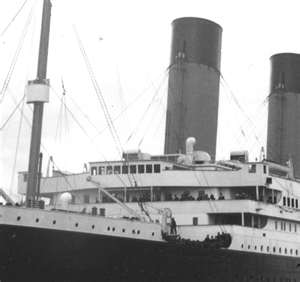
Launched on 20th October 1910 Olympic was the first of the trio of White Star Liners. Under the command of Captain E.J. Smith (who was later to command the Titanic) she sailed on June 14th 1911 on her Maiden voyage to New York.
The Olympic was received well, but on 20th September 1911 she was involved in a collision with cruiser HMS Hawke. After limping back to Belfast she was repaired using components from her sister (Titanic) then under construction.
After the Titanic disaster, Olympic underwent various safety improvements including lifeboats for all aboard, and in October 1912 she returned to Belfast again for installation of an inner watertight skin.
On 1st September 1915 the Olympic was requisitioned by the British Government for war service as a troopship. Later she received a coat of dazzle paint designed to confuse enemy observers. Perhaps her most famous exploit of the war years was when she struck and sank a German submarine, U103.
After the war she returned to commercial service, and despite her early mishaps, she gained an affectionate following and earned the nickname "Old Reliable".
Her bad luck returned on 15th May 1934 when the Olympic collided with the Nantucket lightship with the loss of 7 lives.
Her last voyage ended in Southampton on April 12th 1935, on 13th October 1935 she arrived Palmers Yard on the Tyne for breaking up. Her pitiful remains were finally towed to Inverkeithing on 19th September 1937 for final demolition.
The wooden steamship was constructed in 1863 by the John Litherbury Shipyard in Cincinnati, and intended for the lower Mississippi cotton trade. Registering 1,719 tons,[2] the steamer normally carried a crew of 85. For two years, the Sultana ran a regular route between St. Louis and New Orleans, frequently commissioned to carry troops.
Nuestra Señora de Atocha ("Our Lady of Atocha") was the most famous of a fleet of Spanish ships that sank in 1622 off the Florida Keys while carrying copper, silver, gold, tobacco, gems, jewels, jewelry and indigo from Spanish ports at Cartagena, Colombia, Porto Bello in New Granada and Havana bound for Spain. The ship was named for the parish of Atocha in Madrid.
An unfortunate series of complications kept the Atocha in Veracruz before she could rendezvous in Havana with the vessels of the Tierra Firme (Mainland) Fleet. After still more delays in Havana, what was ultimately a 28-ship convoy did not manage to depart for Spain until September 4, 1622, six weeks behind schedule.
On September 6, the Atocha was driven by a severe hurricane onto the coral reefs near the Dry Tortugas, about 35 miles (56 kilometers) west of Key West. With her hull badly damaged, the vessel quickly sank, drowning everyone on board except for three sailors and two slaves.
HMS Royal George was a 100-gun first-rate ship of the line of the Royal Navy, built at Woolwich Dockyard and launched on 18 February 1756. The largest warship in the world at the time of launching, she saw service during the Seven Years' War including being Admiral Sir Edward Hawke's flagship at the Battle of Quiberon Bay and later taking part in the Battle of Cape St Vincent. She sank undergoing routine maintenance work whilst anchored off Portsmouth on 29 August 1782 with the loss of more than 800 lives, one of the most serious maritime losses to occur in British waters.
USS Murphy (DD-603) was a Benson-class destroyer in the United States Navy during World War II. She was named for Lieutenant John McLeod Murphy.
RMS Titanic was a passenger liner that sank in the North Atlantic Ocean on 15 April 1912 after colliding with an iceberg during her maiden voyage from Southampton to New York City. The sinking of Titanic caused the deaths of 1,517 people in one of the deadliest peacetime maritime disasters in history. She was the largest ship afloat at the time of her maiden voyage. One of three Olympic class ocean liners operated by the White Star Line, she was built between 1909–11 by the Harland and Wolff shipyard in Belfast. She carried over 2,200 people – 1,316 passengers and about 900 crew.